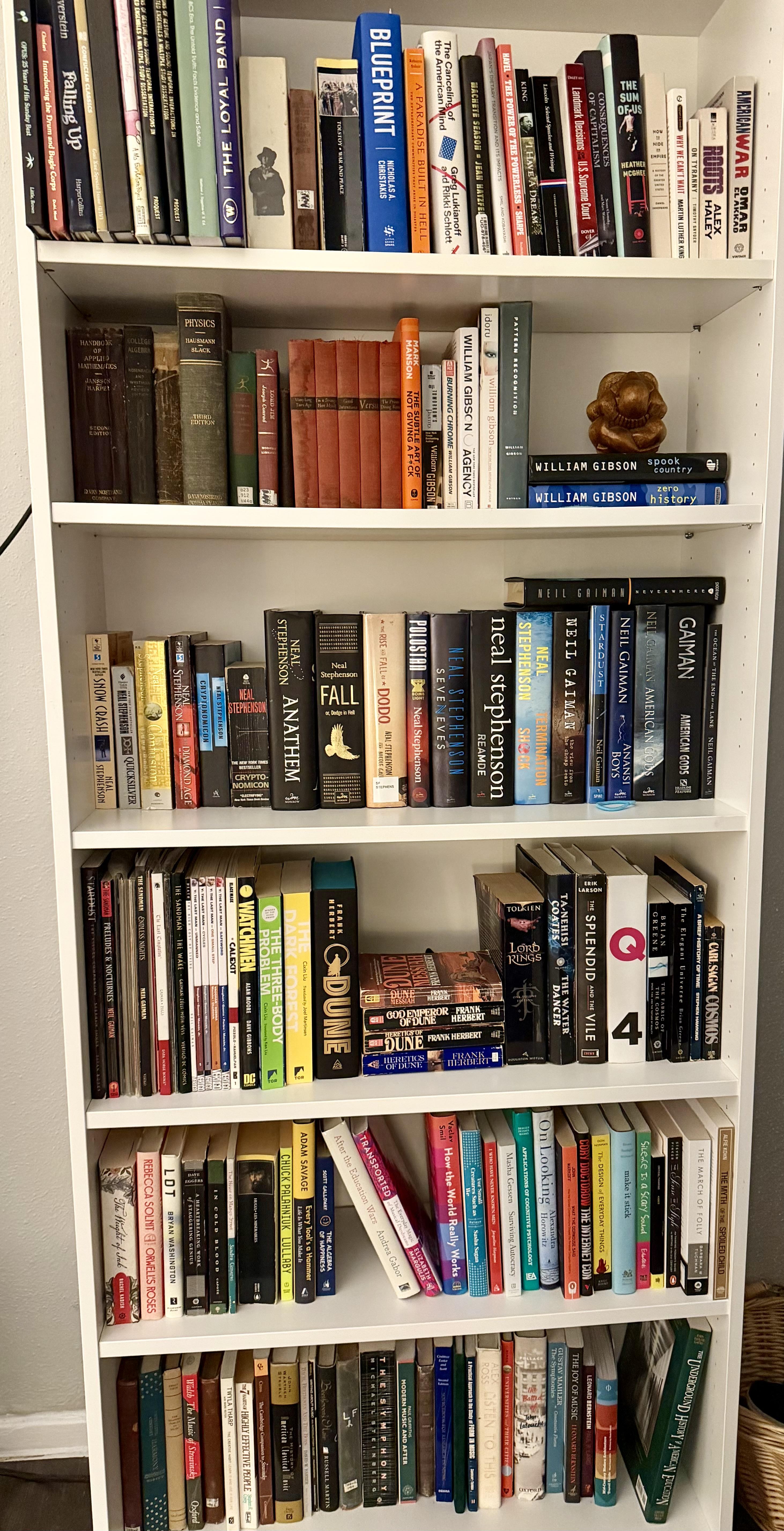
Shelfology Book Pairing
The Bhagavad Gita
by Eknath Easwaran
The Bhagavad Gita, “The Song of the Lord,” is the best known and most read of all the Indian scriptures, featured on college reading lists, quoted in yoga magazines, found in all good libraries and bookstores, and recognized as part of the wisdom literature of all time. Easwaran held the Gita to be India’s greatest gift to the world, and he found in it his most profound source of inspiration. He started teaching classes on the Gita in Berkeley in the sixties, and continued to bring his unfailing enthusiasm to a wide audience throughout his life. Readers have always appreciated the authenticity of his translation, which regularly tops the bestseller list of its genre and has consistently been the bestselling book for Nilgiri Press. The Gita opens, dramatically, on a battlefield. Prince Arjuna, a great warrior and a man of principle, is about to face the treacherous relatives who have deprived his elder brother of his crown. Just as the battle is about to begin, however, Arjuna collapses in his chariot, his bow falling to his side, unable to face the inevitable slaughter ahead of him. Arjuna’s struggle is profoundly modern. He has lost his way on the battlefield of life, and turns to a higher, spiritual power to find the path once again. About to go into the fight of his life, he asks direct, uncompromising questions of his spiritual guide, Sri Krishna. Acting as Arjuna’s friend and charioteer, Krishna is in reality the Lord himself. In seven hundred verses of sublime instruction, Krishna talks of living and dying, of loving and working, of the nature of the soul and the paths we can take to realize our true Self, our true stature. For, as Easwaran points out, the Gita is not what it seems – it’s not a dialogue between two mythical figures at the dawn of Indian time. “The battlefield is a perfect backdrop, but the Gita’s subject is the war within, the struggle for self-mastery that every human being must wage” to live a life that is meaningful, fulfilling, worthwhile. Arjuna represents each of us, every person of action and principle today. Krishna is not an external deity “but the spark of divinity that lies at the core of the human personality.” And this is no external dialogue, but one that takes place within us as we struggle, like Arjuna, to do what is right. Easwaran’s genius is to show us that the Gita is not just a text that is interesting historically and culturally – it’s a practical manual, a book of choices, that offers guidance for whatever challenges we face. It places human destiny entirely in human hands. The range of paths the Gita describes for spiritual realization – of action, wisdom, devotion, and meditation – is broad enough to appeal to all our different personalities. Great figures like Gandhi turned to the Gita again and again, and so can we.
The Catcher in the Rye
by Jerome David Salinger
J. D. Salinger wrote one of the most famous books ever written, The Catcher in the Rye. Salinger wrote many stories and, in 1941, after several rejections, Salinger finally cracked The New Yorker, with a story, "Slight Rebellion Off Madison," that was an early sketch of what became a scene in "The Catcher in the Rye." The magazine then had second thoughts in part because of World War II in which Salinger was in combat, and held the story for five years before finally publishing it in 1946, buried in the back of an issue. Everyone was surprised when the story and the book that followed it became a bit hit. Even today nobody can really explain why Catcher in the Rye is so famous and so popular. Yet, millions have been sold and are still being sold even though only available as used books nowadays. When The Catcher in the Rye was published in 1951, it was registered for copyright as "additional material." This obviously referred to the earlier work "Slight Rebellion Off Madison." The copyright page on "The Catcher in the Rye" states "Copyright 1945, 1946, 1951 by J. D Salinger." The date of 1945 obviously refers to the publication of "I'm Crazy," a short story written by Salinger and published in the December 22, 1945 issue of Collier's magazine that first introduced the character Holden Caulfield to the reading public. Salinger later reworked this short story to incorporate it into The Catcher in the Rye. The two earlier stories are "I'm Crazy," an early version of Holden's departure from prep school that later shows up in The Catcher in the Rye. With minor alteration, much of this story is familiar to readers as the chapter where Holden visits Mr. Spencer. What sets this story apart is the presence of an additional Caulfield sister and the clarity of Holden's resignation and compromise at the end. "Slight Rebellion off Madison" is an early version of another scene in The Catcher in the Rye. The story follows Holden when he is home from Pency and goes to the movies, then skating with Sally Hayes, followed by his drunken calls to her apartment late at night. An early story, it is the first of Salinger's Caulfied works to be accepted for publication.
These books are No Strangers
These books sit together on 3 different collections in our database