Shelfology Book Pairing
Don Quixote
by Miguel de Cervantes
Don Quixote or Spanish: fully titled The Ingenious Gentleman Don Quixote of La Mancha (Spanish: El ingenioso hidalgo don Quijote de la Mancha , is a Spanish novel by Miguel de Cervantes Saavedra. Published in two volumes, in 1605 and 1615, Don Quixote is considered the most influential work of literature from the Spanish Golden Age and the entire Spanish literary canon. As a founding work of modern Western literature and one of the earliest canonical novels, it regularly appears high on lists of the greatest works of fiction ever published, such as the Bokklubben World Library collection that cites Don Quixote as authors' choice for the "best literary work ever written".The story follows the adventures of a hidalgo named Mr. Alonso Quixano who reads so many chivalric romances that he loses his sanity and decides to set out to revive chivalry, undo wrongs, and bring justice to the world, under the name Don Quixote de la Mancha. He recruits a simple farmer, Sancho Panza, as his squire, who often employs a unique, earthy wit in dealing with Don Quixote's rhetorical orations on antiquated knighthood. Don Quixote, in the first part of the book, does not see the world for what it is and prefers to imagine that he is living out a knightly story. Throughout the novel, Cervantes uses such literary techniques as realism, metatheatre, and intertextuality. It had a major influence on the literary community, as evidenced by direct references in Alexandre Dumas' The Three Musketeers (1844), Mark Twain's Adventures of Huckleberry Finn (1884) and Edmond Rostand's Cyrano de Bergerac (1897), as well as the word "quixotic". Arthur Schopenhauer cited Don Quixote as one of the four greatest novels ever written, along with Tristram Shandy, La Nouvelle H�lo�se and Wilhelm Meister.
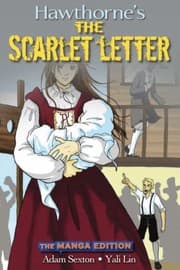
The Scarlet Letter
A Novel by Nathaniel Hawthorne
by Nathaniel HAWTHORNE
The Scarlet Letter opens with a long preamble about how the book came to be written. The nameless narrator was the surveyor of the customhouse in Salem, Massachusetts. In the customhouse's attic, he discovered a number of documents, among them a manuscript that was bundled with a scarlet, gold-embroidered patch of cloth in the shape of an "A." The manuscript, the work of a past surveyor, detailed events that occurred some two hundred years before the narrator's time. When the narrator lost his customs post, he decided to write a fictional account of the events recorded in the manuscript. The Scarlet Letter is the final product. The story begins in seventeenth-century Boston, then a Puritan settlement. A young woman, Hester Prynne, is led from the town prison with her infant daughter, Pearl, in her arms and the scarlet letter "A" on her breast. A man in the crowd tells an elderly onlooker that Hester is being punished for adultery. Hester's husband, a scholar much older than she is, sent her ahead to America, but he never arrived in Boston. The consensus is that he has been lost at sea. While waiting for her husband, Hester has apparently had an affair, as she has given birth to a child. She will not reveal her lover's identity, however, and the scarlet letter, along with her public shaming, is her punishment for her sin and her secrecy. On this day Hester is led to the town scaffold and harangued by the town fathers, but she again refuses to identify her child's father.
These books are No Strangers
These books sit together on 5 different collections in our database