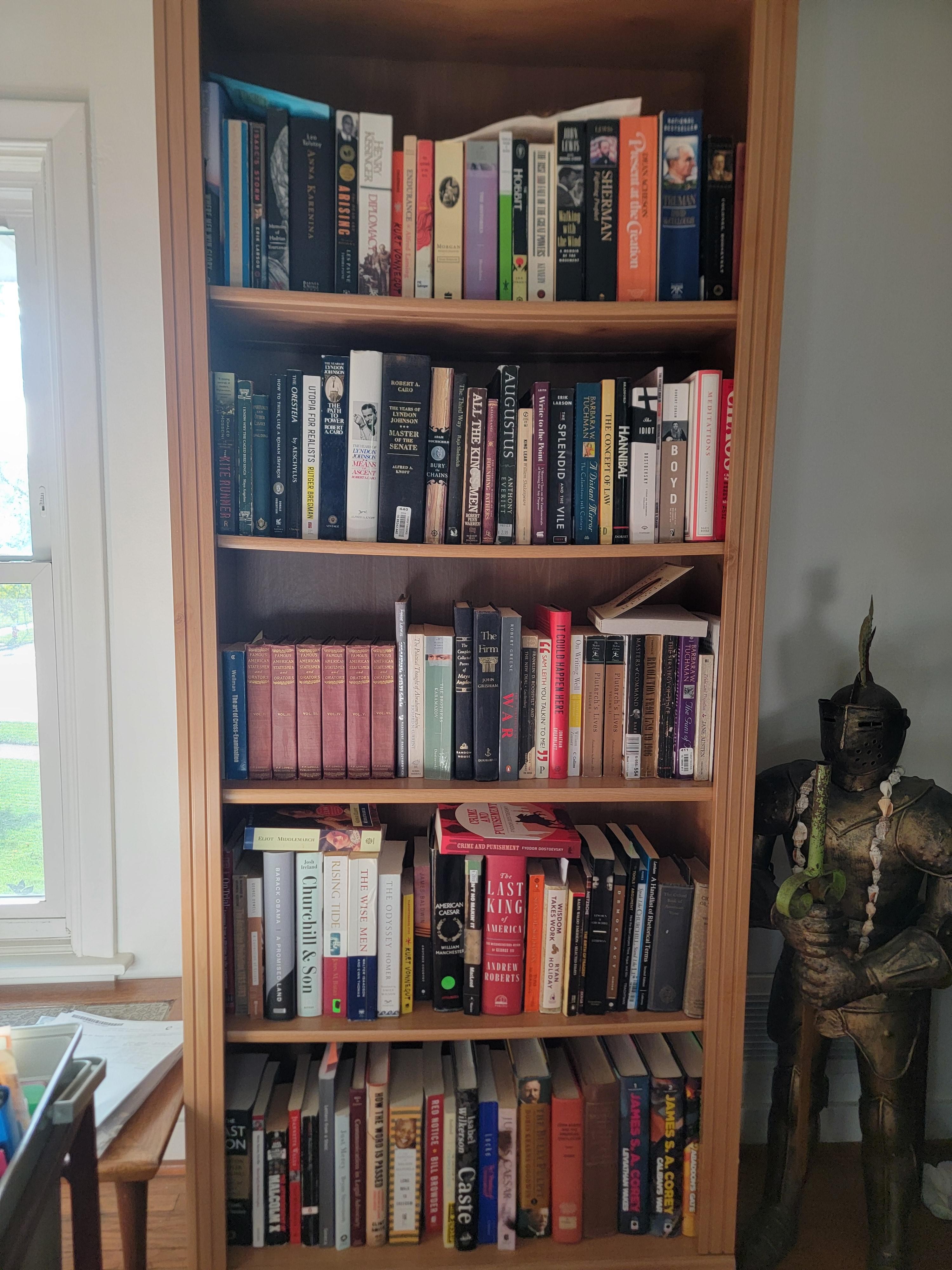
Shelfology Book Pairing
The Federalist Papers
A Collection of 85 Articles and Essays
by Alexander Hamilton
A Collection of 85 Articles and Essays The Federalist Papers By Alexander Hamilton, John Jay, James Madison The Federalist (later known as The Federalist Papers) is a collection of 85 articles and essays written (under the pseudonym Publius) by Alexander Hamilton, James Madison, and John Jay promoting the ratification of the United States Constitution. Seventy-seven were published serially in The Independent Journal and The New York Packet between October 1787 and August 1788. A compilation of these and eight others, called The Federalist; or, The New Constitution, was published in two volumes in 1788 by J. and A. McLean. The collection's original title was The Federalist; the title The Federalist Papers did not emerge until the 20th century. Though the authors of The Federalist Papers foremost wished to influence the vote in favor of ratifying the Constitution, in Federalist No. 1 they explicitly set that debate in broader political terms: It has been frequently remarked, that it seems to have been reserved to the people of this country, by their conduct and example, to decide the important question, whether societies of men are really capable or not, of establishing good government from reflection and choice, or whether they are forever destined to depend, for their political constitutions, on accident and force. Highlights abound in the essays of The Federalist. Federalist No. 10, in which Madison discusses the means of preventing rule by majority faction and advocates a large, commercial republic, is generally regarded as the most important of the 85 articles from a philosophical perspective; it is complemented by Federalist No. 14, in which Madison takes the measure of the United States, declares it appropriate for an extended republic, and concludes with a memorable defense of the constitutional and political creativity of the Federal Convention. In Federalist No. 84, Hamilton makes the case that there is no need to amend the Constitution by adding a Bill of Rights, insisting that the various provisions in the proposed Constitution protecting liberty amount to a "bill of rights". Federalist No. 78, also written by Hamilton, lays the groundwork for the doctrine of judicial review by federal courts of federal legislation or executive acts. Federalist No. 70 presents Hamilton's case for a one-man chief executive. In Federalist No. 39, Madison presents the clearest exposition of what has come to be called "Federalism". In Federalist No. 51, Madison distills arguments for checks and balances in an essay often quoted for its justification of government as "the greatest of all reflections on human nature." EXAMPLE FEDERALIST No. 1. General Introduction FEDERALIST No. 2. Concerning Dangers from Foreign Force and Influence FEDERALIST No. 3. The Same Subject Continued (Concerning Dangers From Foreign Force and Influence) FEDERALIST No. 4. The Same Subject Continued (Concerning Dangers From Foreign Force and Influence) FEDERALIST No. 5. The Same Subject Continued (Concerning Dangers From Foreign Force and Influence) FEDERALIST No. 6. Concerning Dangers from Dissensions Between the States FEDERALIST No. 7. The Same Subject Continued (Concerning Dangers from Dissensions Between the States) FEDERALIST No. 8. The Consequences of Hostilities Between the States FEDERALIST No. 9. The Union as a Safeguard Against Domestic Faction and Insurrection FEDERALIST No. 10. The Same Subject Continued (The Union as a Safeguard Against Domestic Faction and Insurrection) FEDERALIST No. 11. The Utility of the Union in Respect to Commercial Relations and a Navy
Crime and Punishment
A Novel by the Russian Author Fyodor Dostoevsky
by Fyodor Dostoevsky
Fyodor Dostoevsky's classic tale of Rodion Raskolnikov, the murder he commits as an exploration of the human condition, and the crushing criminal and psychological consequences. The two years before he wrote Crime and Punishment (1866) had been bad ones for Dostoyevsky. His wife and brother had died; the magazine he and his brother had started, Epoch, collapsed under its load of debt; and he was threatened with debtor's prison. With an advance that he managed to wangle for an unwritten novel, he fled to Wiesbaden, hoping to win enough at the roulette table to get himself out of debt. Instead, he lost all his money; he had to pawn his clothes and beg friends for loans to pay his hotel bill and get back to Russia. One of his begging letters went to a magazine editor, asking for an advance on yet another unwritten novel - which he described as Crime and Punishment. One of the supreme masterpieces of world literature, Crime and Punishment catapulted Dostoyevsky to the forefront of Russian writers and into the ranks of the world's greatest novelists. Drawing upon experiences from his own prison days, the author recounts in feverish, compelling tones the story of Raskolnikov, an impoverished student tormented by his own nihilism, and the struggle between good and evil. Believing that he is above the law, and convinced that humanitarian ends justify vile means, he brutally murders an old woman - a pawnbroker whom he regards as "stupid, ailing, greedy...good for nothing." Overwhelmed afterwards by feelings of guilt and terror, Raskolnikov confesses to the crime and goes to prison. There he realizes that happiness and redemption can only be achieved through suffering. Infused with forceful religious, social, and philosophical elements, the novel was an immediate success. This extraordinary, unforgettable work is reprinted here in the authoritative Constance Garnett translation. Others novels and novellas by Dostoevsky are: (1846) Poor Folk (novella) (1846) The Double (novella) (1847) The Landlady (novella) (1849) Netochka Nezvanova (unfinished) (1859) Uncle's Dream (novella) (1859) The Village of Stepanchikovo (1861) Humiliated and Insulted (1862) The House of the Dead (1864) Notes from Underground (novella) (1866) Crime and Punishment (1867) The Gambler (novella) (1869) The Idiot (1870) The Eternal Husband (novella) (1872) Demons (also titled: The Possessed, The Devils) (1875) The Adolescent (1880) The Brothers Karamazov
These books are No Strangers
These books sit together on 5 different collections in our database