Shelfology Book Pairing
Les Misérables - Volume 2
By Victor Hugo - Illustrated
by Victor Victor Hugo
How is this book unique? Font adjustments & biography included Unabridged (100% Original content) Illustrated About Les Mis�rables by Victor Hugo Les Mis�rables (pronounced /leɪ ˌmɪzəˈrɑːb/ or /leɪ ˈmɪzəˌrɑːb/; French pronunciation: ) is a French historical novel by Victor Hugo, first published in 1862, that is considered one of the greatest novels of the 19th century. In the English-speaking world, the novel is usually referred to by its original French title. However, several alternatives have been used, including The Miserables, The Wretched, The Miserable Ones, The Poor Ones, The Wretched Poor, The Victims and The Dispossessed. Beginning in 1815 and culminating in the 1832 June Rebellion in Paris, the novel follows the lives and interactions of several characters, particularly the struggles of ex-convict Jean Valjean and his experience of redemption. Examining the nature of law and grace, the novel elaborates upon the history of France, the architecture and urban design of Paris, politics, moral philosophy, antimonarchism, justice, religion, and the types and nature of romantic and familial love. Les Mis�rables has been popularized through numerous adaptations for the stage, television, and film, including a musical and a film adaptation of that musical. The appearance of the novel was highly anticipated and advertised. Critical reactions were diverse, but most of them were negative. Commercially, the work was a great success globally.
Crime and Punishment
A Novel by the Russian Author Fyodor Dostoevsky
by Fyodor Dostoevsky
Fyodor Dostoevsky's classic tale of Rodion Raskolnikov, the murder he commits as an exploration of the human condition, and the crushing criminal and psychological consequences. The two years before he wrote Crime and Punishment (1866) had been bad ones for Dostoyevsky. His wife and brother had died; the magazine he and his brother had started, Epoch, collapsed under its load of debt; and he was threatened with debtor's prison. With an advance that he managed to wangle for an unwritten novel, he fled to Wiesbaden, hoping to win enough at the roulette table to get himself out of debt. Instead, he lost all his money; he had to pawn his clothes and beg friends for loans to pay his hotel bill and get back to Russia. One of his begging letters went to a magazine editor, asking for an advance on yet another unwritten novel - which he described as Crime and Punishment. One of the supreme masterpieces of world literature, Crime and Punishment catapulted Dostoyevsky to the forefront of Russian writers and into the ranks of the world's greatest novelists. Drawing upon experiences from his own prison days, the author recounts in feverish, compelling tones the story of Raskolnikov, an impoverished student tormented by his own nihilism, and the struggle between good and evil. Believing that he is above the law, and convinced that humanitarian ends justify vile means, he brutally murders an old woman - a pawnbroker whom he regards as "stupid, ailing, greedy...good for nothing." Overwhelmed afterwards by feelings of guilt and terror, Raskolnikov confesses to the crime and goes to prison. There he realizes that happiness and redemption can only be achieved through suffering. Infused with forceful religious, social, and philosophical elements, the novel was an immediate success. This extraordinary, unforgettable work is reprinted here in the authoritative Constance Garnett translation. Others novels and novellas by Dostoevsky are: (1846) Poor Folk (novella) (1846) The Double (novella) (1847) The Landlady (novella) (1849) Netochka Nezvanova (unfinished) (1859) Uncle's Dream (novella) (1859) The Village of Stepanchikovo (1861) Humiliated and Insulted (1862) The House of the Dead (1864) Notes from Underground (novella) (1866) Crime and Punishment (1867) The Gambler (novella) (1869) The Idiot (1870) The Eternal Husband (novella) (1872) Demons (also titled: The Possessed, The Devils) (1875) The Adolescent (1880) The Brothers Karamazov
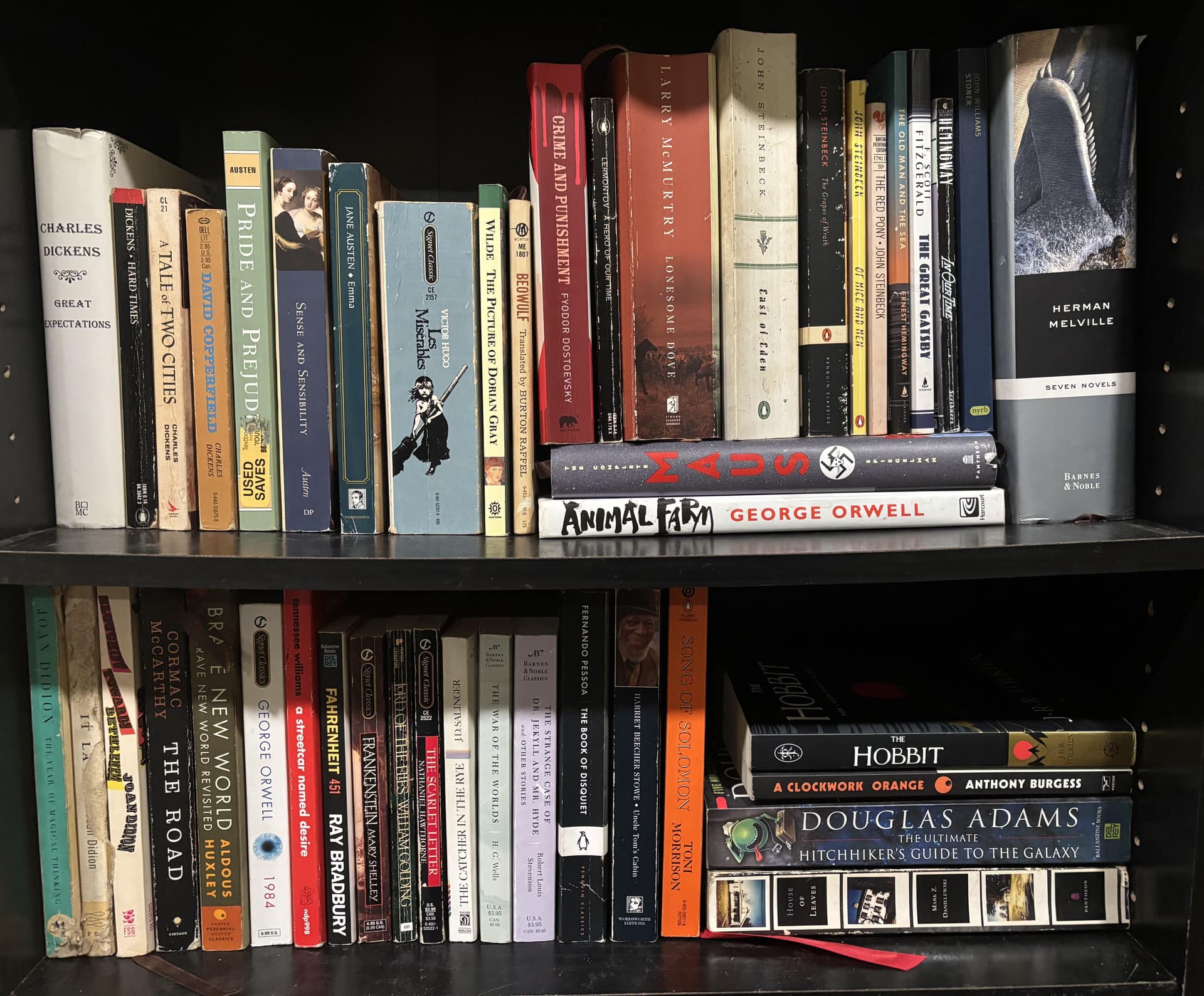
These books are Shelf Soulmates
These books sit together on 7 different collections in our database