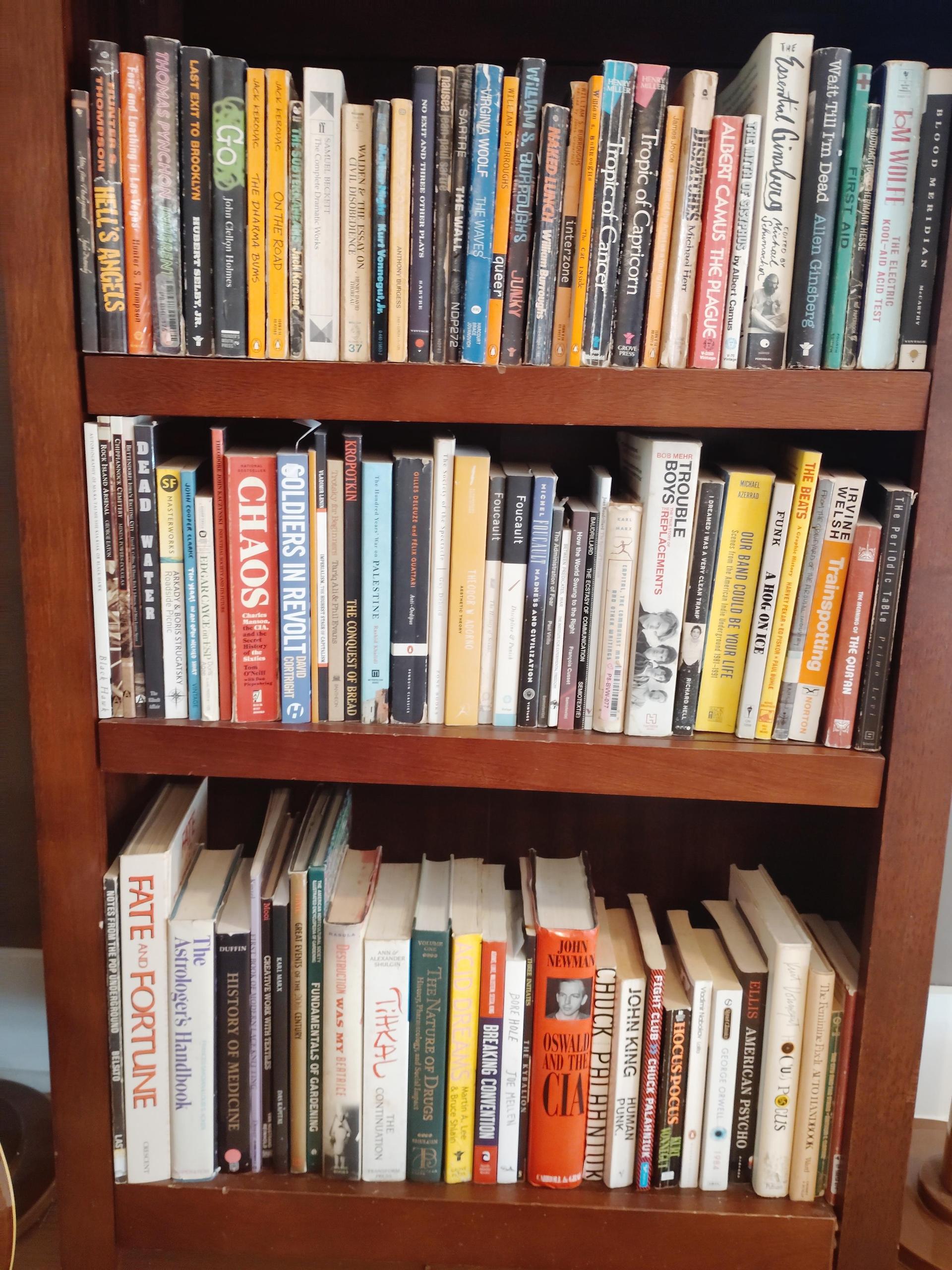
Shelfology Book Pairing
Anti-Oedipus
by Gilles Deleuze
‘A major philosophical work by perhaps the most brilliant philosophical mind at work in France today.' Fredric Jameson Gilles Deleuze (1925-1995) was Professor of Philosophy at the University of Paris VIII. He was a key figure in poststructuralism, and one of the most influential philosophers of the twentieth century. Félix Guattari (1930-1992) was a psychoanalyst at the la Borde Clinic, as well as being a major social theorist and radical activist. Anti-Oedipus is part of Deleuze and Guattari's landmark philosophical project, Capitalism and Schizophrenia - a project that still sets the terms of contemporary philosophical debate. Anti-Oedipus is a radical philosophical analysis of desire that shows how we can combat the compulsion to dominate ourselves and others. As Michel Foucault says in his Preface it is an ‘Introduction to Non-Fascist Living'. Preface by Michel Foucault. Translated by Robert Hurley, Mark Seem, and Helen R. Lane
Tihkal
The Continuation
by Alexander Shulgin
TiHKAL: The Continuation is the sequel to PiHKAL: A Chemical Love Story but can stand alone to any reader. Where PiHKAL focuses on a class of compounds called phenethylamines, TiHKAL is written about a family of psychoactive drugs known as tryptamines with TiHKAL being an acronym for "Tryptamines I Have Known and Loved". Like its predecessor PiHKAL, it is divided into two parts. The first part of the book begins with the story of Alice and Shura, a fictionalized autobiography, which picks up where the similar section of PiHKAL left off. The book opens with the story about the DEA raid that occurred a few years after the publication of their first book, PiHKAL. It's a window into the DEA, the institutional aspect and human side of it as well, and the price that Shura and Alice pay for doing what they do, including exercising their first amendment rights. It then continues with a collection of essays on topics ranging from psychotherapy and the Jungian mind, to the prevalence of DMT in nature, ayahuasca, the War on Drugs, and even the Big Bang. It is a blend of travel, botanical facts, scientific speculation, psychological and political commentary. It is fascinating getting to know the mind of the man behind the compounds - his thoughts on science, technology, law, and society. And the mind of the woman who brought his work and their story into the light of the world. The second part of TiHKAL is "The Chemistry Continues". It is a detailed manual for 55 psychedelic compounds (many discovered by Shulgin himself). For each compound there is information on synthesis, effective dosage, duration of effects, and commentary on the subjective effects that were experienced. The Shulgins' two big books span autobiography, organic chemistry, politics, ethnobotany and psychopharmacology and the cultural impact of these works has been profound and will continue to be so in the future.
These books are Distant Cousins
These books sit together on 2 different collections in our database