Shelfology Book Pairing
Behave
The Biology of Humans at Our Best and Worst
by Robert M. Sapolsky
Why do we do the things we do? Over a decade in the making, this game-changing book is Robert Sapolsky's genre-shattering attempt to answer that question as fully as perhaps only he could, looking at it from every angle. Sapolsky's storytelling concept is delightful but it also has a powerful intrinsic logic: he starts by looking at the factors that bear on a person's reaction in the precise moment a behavior occurs, and then hops back in time from there, in stages, ultimately ending up at the deep history of our species and its genetic inheritance. And so the first category of explanation is the neurobiological one. What goes on in a person's brain a second before the behavior happens? Then he pulls out to a slightly larger field of vision, a little earlier in time: What sight, sound, or smell triggers the nervous system to produce that behavior? And then, what hormones act hours to days earlier to change how responsive that individual is to the stimuli which trigger the nervous system? By now, he has increased our field of vision so that we are thinking about neurobiology and the sensory world of our environment and endocrinology in trying to explain what happened. Sapolsky keeps going--next to what features of the environment affected that person's brain, and then back to the childhood of the individual, and then to their genetic makeup. Finally, he expands the view to encompass factors larger than that one individual. How culture has shaped that individual's group, what ecological factors helped shape that culture, and on and on, back to evolutionary factors thousands and even millions of years old. The result is one of the most dazzling tours de horizon of the science of human behavior ever attempted, a majestic synthesis that harvests cutting-edge research across a range of disciplines to provide a subtle and nuanced perspective on why we ultimately do the things we do...for good and for ill. Sapolsky builds on this understanding to wrestle with some of our deepest and thorniest questions relating to tribalism and xenophobia, hierarchy and competition, morality and free will, and war and peace. Wise, humane, often very funny, Behave is a towering achievement, powerfully humanizing, and downright heroic in its own right.
Leonardo Da Vinci
by Walter Isaacson
The #1 New York Times bestseller "A powerful story of an exhilarating mind and life...a study in creativity: how to define it, how to achieve it." --The New Yorker "Vigorous, insightful." --The Washington Post "A masterpiece." --San Francisco Chronicle "Luminous." --The Daily Beast He was history's most creative genius. What secrets can he teach us? The author of the acclaimed bestsellers Steve Jobs, Einstein, and Benjamin Franklin brings Leonardo da Vinci to life in this exciting new biography. Based on thousands of pages from Leonardo's astonishing notebooks and new discoveries about his life and work, Walter Isaacson weaves a narrative that connects his art to his science. He shows how Leonardo's genius was based on skills we can improve in ourselves, such as passionate curiosity, careful observation, and an imagination so playful that it flirted with fantasy. He produced the two most famous paintings in history, The Last Supper and the Mona Lisa. But in his own mind, he was just as much a man of science and technology. With a passion that sometimes became obsessive, he pursued innovative studies of anatomy, fossils, birds, the heart, flying machines, botany, geology, and weaponry. His ability to stand at the crossroads of the humanities and the sciences, made iconic by his drawing of Vitruvian Man, made him history's most creative genius. His creativity, like that of other great innovators, came from having wide-ranging passions. He peeled flesh off the faces of cadavers, drew the muscles that move the lips, and then painted history's most memorable smile. He explored the math of optics, showed how light rays strike the cornea, and produced illusions of changing perspectives in The Last Supper. Isaacson also describes how Leonardo's lifelong enthusiasm for staging theatrical productions informed his paintings and inventions. Leonardo's delight at combining diverse passions remains the ultimate recipe for creativity. So, too, does his ease at being a bit of a misfit: illegitimate, gay, vegetarian, left-handed, easily distracted, and at times heretical. His life should remind us of the importance of instilling, both in ourselves and our children, not just received knowledge but a willingness to question it--to be imaginative and, like talented misfits and rebels in any era, to think different.
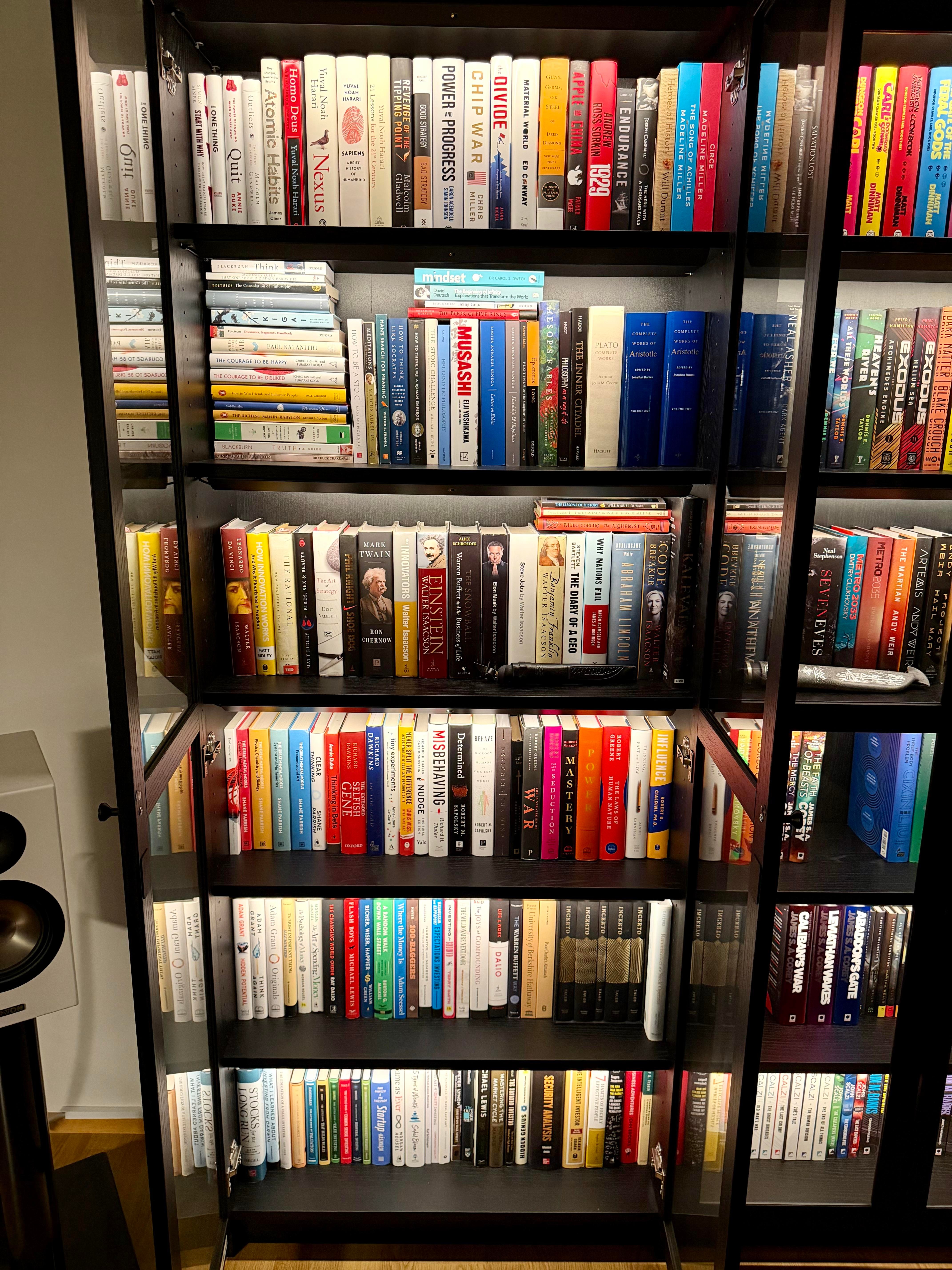
These books are No Strangers
These books sit together on 3 different collections in our database