Shelfology Book Pairing
The Brothers Karamazov
Introduction by Malcolm Jones
by Fyodor Dostoevsky
Dostoevsky’s greatest novel is a story of murder told with hair-raising intellectual clarity and a feeling for the human condition unsurpassed in world literature. Fyodor Dostoevsky’s final novel, published just before his death in 1881, chronicles the bitter love-hate struggle between a larger-than-life father and his three very different sons. The author's towering reputation as one of the handful of thinkers who forged the modern sensibility has sometimes obscured the purely novelistic virtues—brilliant characterizations, flair for suspense and melodrama, instinctive theatricality—that made his work so immensely popular in nineteenth-century Russia. This award-winning translation by Richard Pevear and Larissa Volokhonsky—the definitive version in English—magnificently captures the rich and subtle energies of Dostoevsky’s masterpiece." Everyman's Library pursues the highest production standards, printing on acid-free cream-colored paper, with full-cloth cases with two-color foil stamping, decorative endpapers, silk ribbon markers, European-style half-round spines, and a full-color illustrated jacket. Everyman’s Library Classics include an introduction, a select bibliography, and a chronology of the author's life and times.
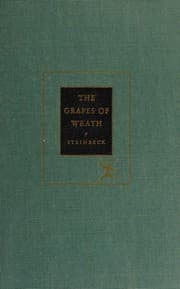
The Grapes of Wrath
(Annotated Edition)
by John John Steinbeck
John Steinbeck's novel The Grapes of Wrath tells the specific story of the Joad family, and thus illustrates the hardships and oppression suffered by migrant laborers during the Great Depression. It is an explicitly political piece of writing, one that champions collective action by the lower classes. In taking this social stance, Steinbeck's novel criticizes shortsighted self-interest and chastises corporate and banking elites for profit-maximizing policies that ultimately forced farmers into destitution and even starvation. The novel begins with a description of the conditions in Dust Bowl Oklahoma that ruined crops and instigated massive foreclosures on farmland. No specific characters emerge initially; this is a technique that Steinbeck will employ several times in the book, posing descriptions of events in a large social context against descriptions of events more particular to the Joad family. Tom Joad, a man not yet thirty, approaches a diner dressed in spotless, somewhat formal clothing. He hitches a ride with a truck driver, who presses Tom for information until Tom finally reveals that he was just released from McAlester prison, where he served four years for murdering a man during a fight. Steinbeck follows this exchange with an interlude describing a turtle crossing the road, which serves as a metaphor for the struggles of the working class.