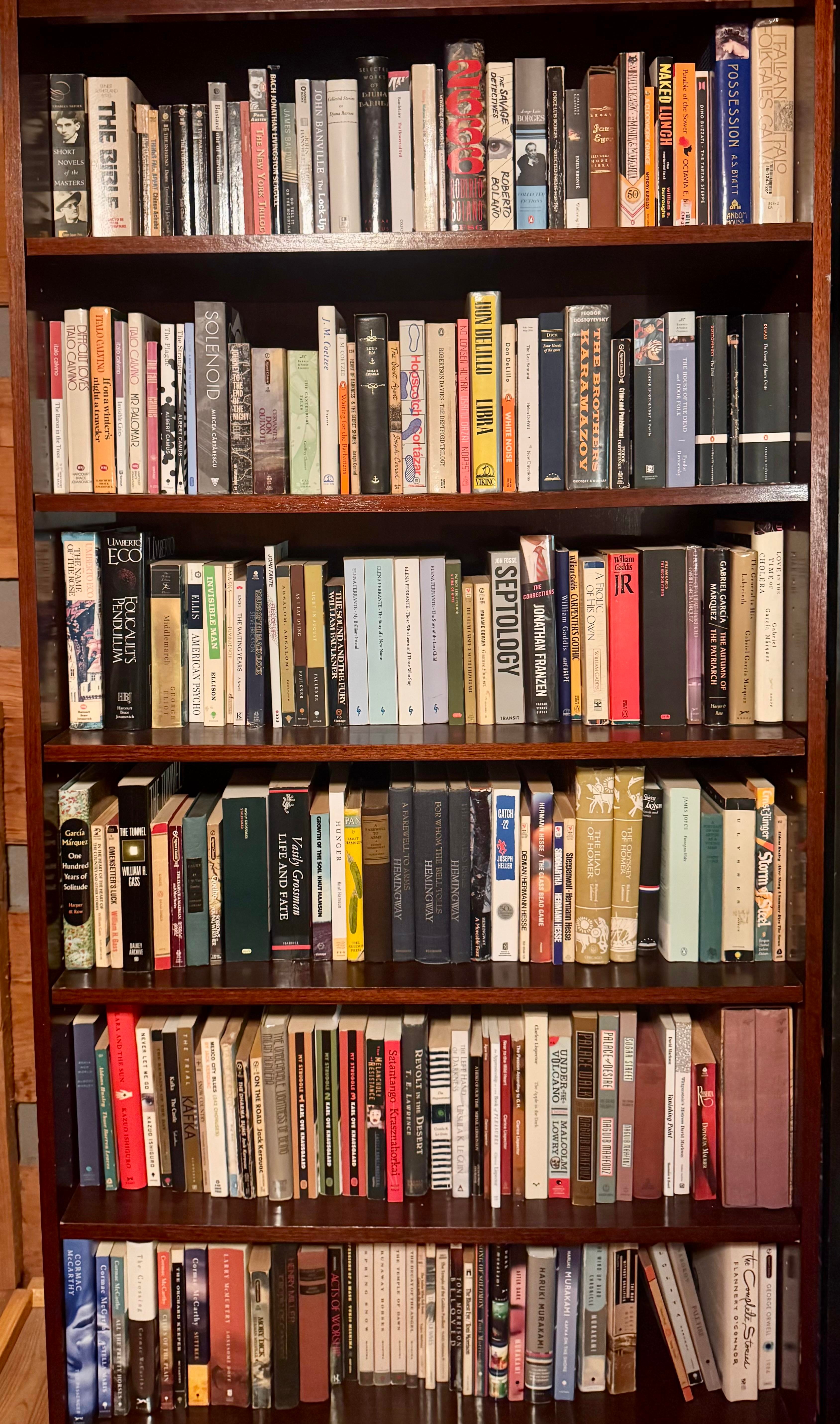
Shelfology Book Pairing
The Brothers Karamazov
Introduction by Malcolm Jones
by Fyodor Dostoevsky
Dostoevsky’s greatest novel is a story of murder told with hair-raising intellectual clarity and a feeling for the human condition unsurpassed in world literature. Fyodor Dostoevsky’s final novel, published just before his death in 1881, chronicles the bitter love-hate struggle between a larger-than-life father and his three very different sons. The author's towering reputation as one of the handful of thinkers who forged the modern sensibility has sometimes obscured the purely novelistic virtues—brilliant characterizations, flair for suspense and melodrama, instinctive theatricality—that made his work so immensely popular in nineteenth-century Russia. This award-winning translation by Richard Pevear and Larissa Volokhonsky—the definitive version in English—magnificently captures the rich and subtle energies of Dostoevsky’s masterpiece." Everyman's Library pursues the highest production standards, printing on acid-free cream-colored paper, with full-cloth cases with two-color foil stamping, decorative endpapers, silk ribbon markers, European-style half-round spines, and a full-color illustrated jacket. Everyman’s Library Classics include an introduction, a select bibliography, and a chronology of the author's life and times.
Don Quixote
by Miguel de Cervantes
Don Quixote or Spanish: fully titled The Ingenious Gentleman Don Quixote of La Mancha (Spanish: El ingenioso hidalgo don Quijote de la Mancha , is a Spanish novel by Miguel de Cervantes Saavedra. Published in two volumes, in 1605 and 1615, Don Quixote is considered the most influential work of literature from the Spanish Golden Age and the entire Spanish literary canon. As a founding work of modern Western literature and one of the earliest canonical novels, it regularly appears high on lists of the greatest works of fiction ever published, such as the Bokklubben World Library collection that cites Don Quixote as authors' choice for the "best literary work ever written".The story follows the adventures of a hidalgo named Mr. Alonso Quixano who reads so many chivalric romances that he loses his sanity and decides to set out to revive chivalry, undo wrongs, and bring justice to the world, under the name Don Quixote de la Mancha. He recruits a simple farmer, Sancho Panza, as his squire, who often employs a unique, earthy wit in dealing with Don Quixote's rhetorical orations on antiquated knighthood. Don Quixote, in the first part of the book, does not see the world for what it is and prefers to imagine that he is living out a knightly story. Throughout the novel, Cervantes uses such literary techniques as realism, metatheatre, and intertextuality. It had a major influence on the literary community, as evidenced by direct references in Alexandre Dumas' The Three Musketeers (1844), Mark Twain's Adventures of Huckleberry Finn (1884) and Edmond Rostand's Cyrano de Bergerac (1897), as well as the word "quixotic". Arthur Schopenhauer cited Don Quixote as one of the four greatest novels ever written, along with Tristram Shandy, La Nouvelle H�lo�se and Wilhelm Meister.
These books are Shelf Soulmates
These books sit together on 9 different collections in our database