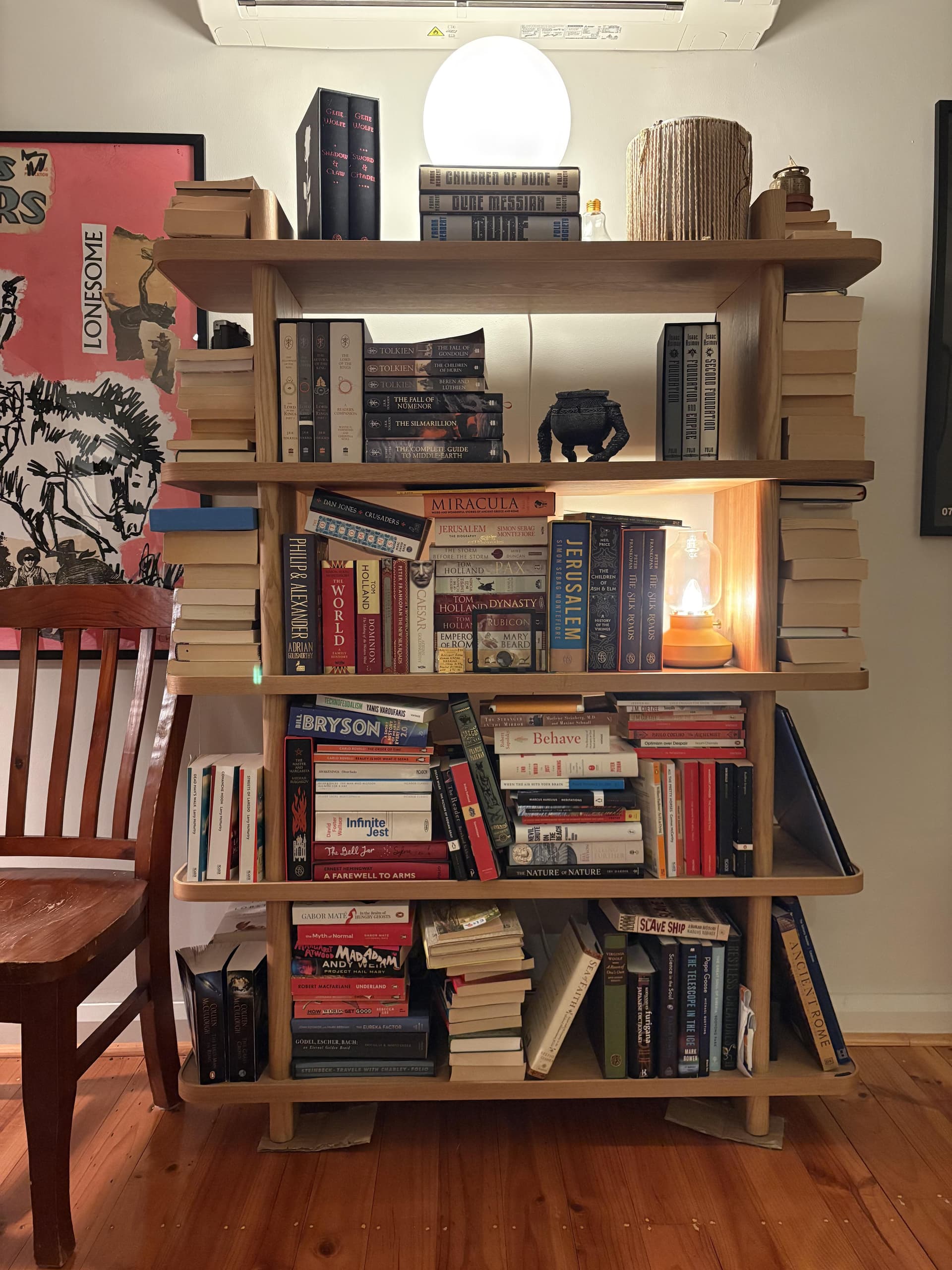
Shelfology Book Pairing
Say Nothing
A True Story of Murder and Memory in Northern Ireland
by Patrick Radden Keefe
NEW YORK TIMES BESTSELLER • NOW AN FX LIMITED SERIES STREAMING ON HULU • NATIONAL BOOK CRITICS CIRCLE AWARD WINNER • From the author of Empire of Pain—a stunning, intricate narrative about a notorious killing in Northern Ireland and its devastating repercussions. One of The New York Times’s 20 Best Books of the 21st Century • A Kirkus Reviews Best Nonfiction Book of the Century • A Los Angeles Times Best Nonfiction Book of the Last 30 Years "Masked intruders dragged Jean McConville, a 38-year-old widow and mother of 10, from her Belfast home in 1972. In this meticulously reported book—as finely paced as a novel—Keefe uses McConville's murder as a prism to tell the history of the Troubles in Northern Ireland. Interviewing people on both sides of the conflict, he transforms the tragic damage and waste of the era into a searing, utterly gripping saga." —New York Times Book Review "Reads like a novel. . . . Keefe is . . . a master of narrative nonfiction. . . . An incredible story."—Rolling Stone A Best Book of the Year: The New York Times, The Washington Post, The Wall Street Journal, TIME, NPR, and more! Jean McConville's abduction was one of the most notorious episodes of the vicious conflict known as The Troubles. Everyone in the neighborhood knew the I.R.A. was responsible. But in a climate of fear and paranoia, no one would speak of it. In 2003, five years after an accord brought an uneasy peace to Northern Ireland, a set of human bones was discovered on a beach. McConville's children knew it was their mother when they were told a blue safety pin was attached to the dress--with so many kids, she had always kept it handy for diapers or ripped clothes. Patrick Radden Keefe's mesmerizing book on the bitter conflict in Northern Ireland and its aftermath uses the McConville case as a starting point for the tale of a society wracked by a violent guerrilla war, a war whose consequences have never been reckoned with. The brutal violence seared not only people like the McConville children, but also I.R.A. members embittered by a peace that fell far short of the goal of a united Ireland, and left them wondering whether the killings they committed were not justified acts of war, but simple murders. From radical and impetuous I.R.A. terrorists such as Dolours Price, who, when she was barely out of her teens, was already planting bombs in London and targeting informers for execution, to the ferocious I.R.A. mastermind known as The Dark, to the spy games and dirty schemes of the British Army, to Gerry Adams, who negotiated the peace but betrayed his hardcore comrades by denying his I.R.A. past--Say Nothing conjures a world of passion, betrayal, vengeance, and anguish.
The Catcher in the Rye
by Jerome David Salinger
J. D. Salinger wrote one of the most famous books ever written, The Catcher in the Rye. Salinger wrote many stories and, in 1941, after several rejections, Salinger finally cracked The New Yorker, with a story, "Slight Rebellion Off Madison," that was an early sketch of what became a scene in "The Catcher in the Rye." The magazine then had second thoughts in part because of World War II in which Salinger was in combat, and held the story for five years before finally publishing it in 1946, buried in the back of an issue. Everyone was surprised when the story and the book that followed it became a bit hit. Even today nobody can really explain why Catcher in the Rye is so famous and so popular. Yet, millions have been sold and are still being sold even though only available as used books nowadays. When The Catcher in the Rye was published in 1951, it was registered for copyright as "additional material." This obviously referred to the earlier work "Slight Rebellion Off Madison." The copyright page on "The Catcher in the Rye" states "Copyright 1945, 1946, 1951 by J. D Salinger." The date of 1945 obviously refers to the publication of "I'm Crazy," a short story written by Salinger and published in the December 22, 1945 issue of Collier's magazine that first introduced the character Holden Caulfield to the reading public. Salinger later reworked this short story to incorporate it into The Catcher in the Rye. The two earlier stories are "I'm Crazy," an early version of Holden's departure from prep school that later shows up in The Catcher in the Rye. With minor alteration, much of this story is familiar to readers as the chapter where Holden visits Mr. Spencer. What sets this story apart is the presence of an additional Caulfield sister and the clarity of Holden's resignation and compromise at the end. "Slight Rebellion off Madison" is an early version of another scene in The Catcher in the Rye. The story follows Holden when he is home from Pency and goes to the movies, then skating with Sally Hayes, followed by his drunken calls to her apartment late at night. An early story, it is the first of Salinger's Caulfied works to be accepted for publication.
These books are No Strangers
These books sit together on 4 different collections in our database