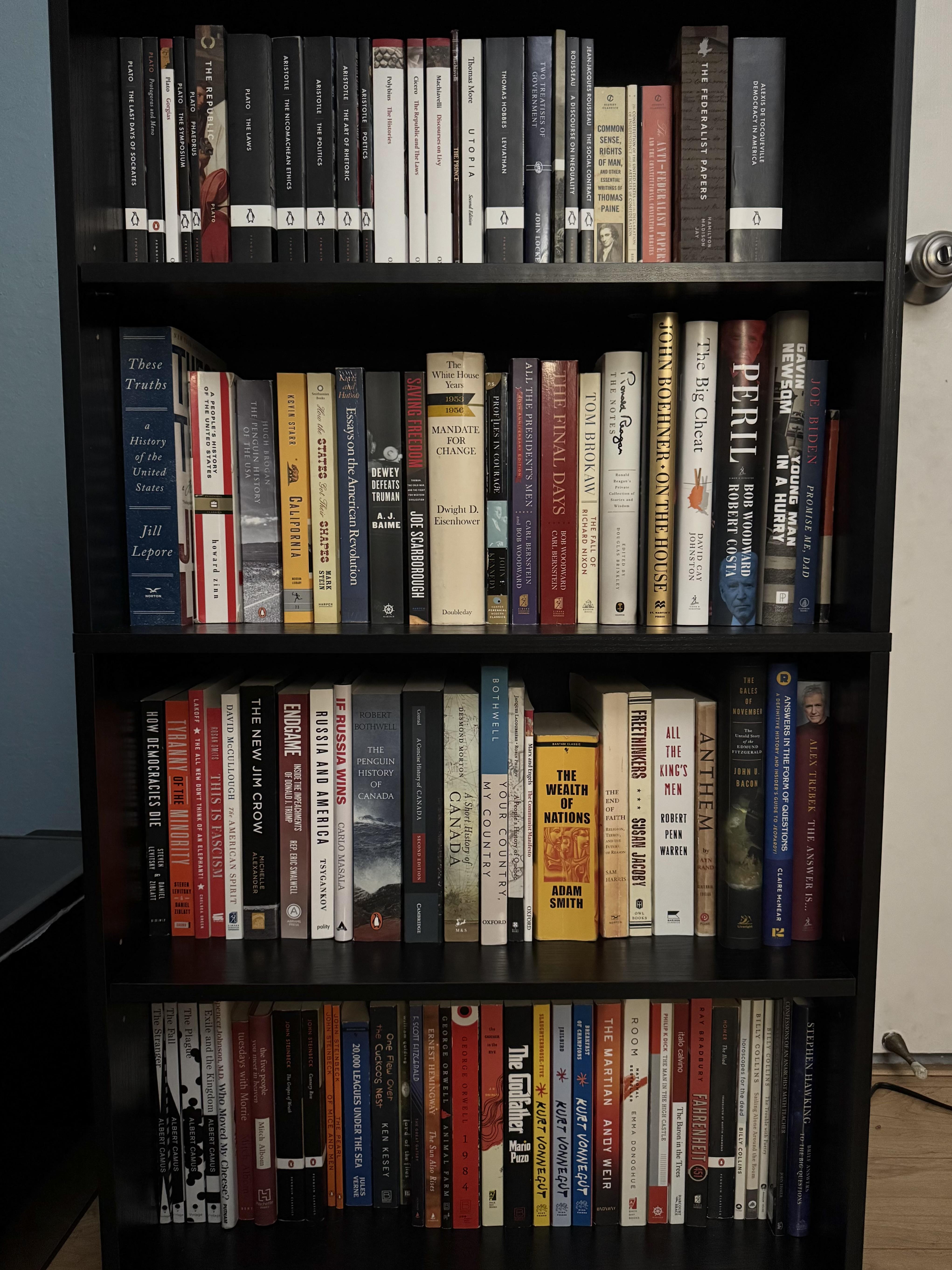
Shelfology Book Pairing
Leviathan
by Thomas Hobbes
'He that is to govern a whole Nation, must read inhimself, not this, or that particular man; but Man-kind.' Thomas Hobbes's Leviathanis not just one of the greatest philosophicaltexts in the English language; it is one of the most important works in thehistory of Western political thought. Almost every major tradition in thecenturies after Hobbes - from radical democracy to authoritarianism - hasbeen influenced by its arguments. Written in exile in a period of dramaticdevelopments - civil war and regicide - Leviathanis in some ways theproduct of its own special circumstances. And yet, at the same time,it deals with fundamental issues that matter to all of us today: the natureand purpose of the state, the relation between human nature and politics,the idea of natural rights, the justification of authority, the concept ofrepresentation, the nature of sovereignty, the limits of obedience, andthe relationship between religious obligations and human ones. This new edition offers a definitive text drawn from more than twentyyears of research by Noel Malcolm, including, in English translation, allthe most significant revisions made in Hobbes's later Latin translation of Leviathan, as well as extensive explanatory notes that elucidate Hobbes'slanguage and identify the many Biblical, classical, and other allusionsthat are scattered through his text.
Two Treatises of Government - Locke
by John Locke
"Treatise of Government" is one of the great classics of Political Philosophy. Its author, John Locke, became one of the greatest philosophers of liberalism and democracy, and his ideas remain relevant and are studied to this day. Locke's thoughts influenced important events in history, particularly in Europe and America. He is often called the theorist of the English Revolution (1688) and was the main source of ideas for the American Revolution (1776), influencing the Declaration of Independence and the state constitutions of that country. In "Second Treatise of Government," John Locke expresses his liberal thinking and his position against absolutist governments with arguments that demonstrate that government emanates from the people and that, together with the law, should be used for the common good.
These books are Distant Cousins
These books sit together on 2 different collections in our database