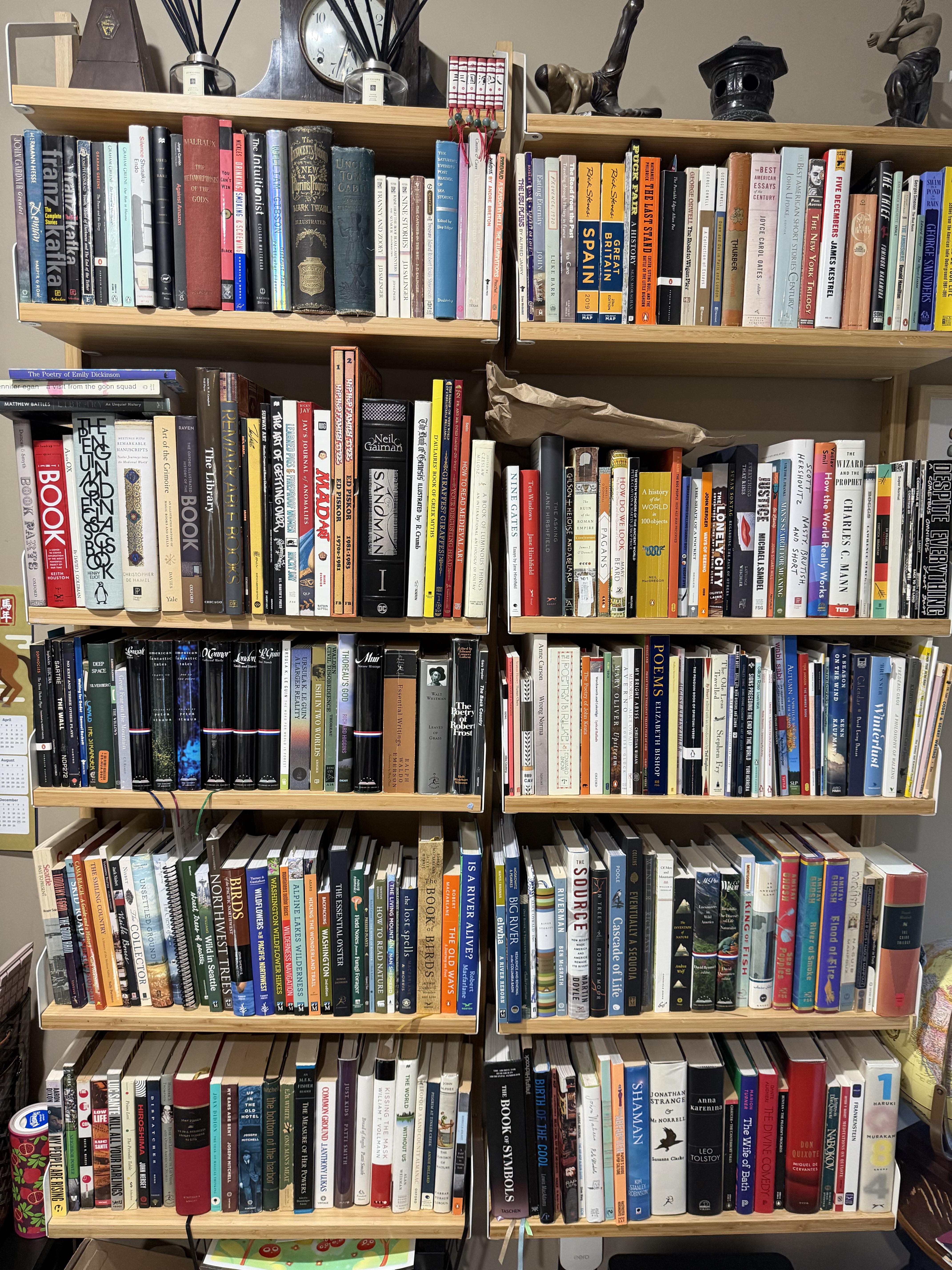
Shelfology Book Pairing
A History of the World in 100 Objects
by Neil MacGregor
This book takes a dramatically original approach to the history of humanity, using objects which previous civilisations have left behind them, often accidentally, as prisms through which we can explore past worlds and the lives of the men and women who lived in them. The book's range is enormous. It begins with one of the earliest surviving objects made by human hands, a chopping tool from the Olduvai gorge in Africa, and ends with an object from the 21st century which represents the world we live in today. Neil MacGregor's aim is not simply to describe these remarkable things, but to show us their significance - how a stone pillar tells us about a great Indian emperor preaching tolerance to his people, how Spanish pieces of eight tell us about the beginning of a global currency or how an early Victorian tea-set tells us about the impact of empire. Each chapter immerses the reader in a past civilisation accompanied by an exceptionally well-informed guide. Seen through this lens, history is a kaleidoscope - shifting, interconnected, constantly surprising, and shaping our world today in ways that most of us have never imagined. An intellectual and visual feast, it is one of the most engrossing and unusual history books published in years.
Anna Karenina (Illustrated)
by Leo Tolstoy
Anna Karenina (Russian: «Анна Каренина»; Russian pronunciation: ) is a novel by the Russian writer Leo Tolstoy, published in serial installments from 1873 to 1877 in the periodical The Russian Messenger. Tolstoy clashed with editor Mikhail Katkov over political issues that arose in the final installment (Tolstoy's unpopular views of volunteers going to Serbia); therefore, the novel's first complete appearance was in book form in 1878. Widely regarded as a pinnacle in realist fiction, Tolstoy considered Anna Karenina his first true novel, when he came to consider War and Peace to be more than a novel. Fyodor Dostoyevsky declared it to be "flawless as a work of art". His opinion was shared by Vladimir Nabokov, who especially admired "the flawless magic of Tolstoy's style", and by William Faulkner, who described the novel as "the best ever written". The novel is currently enjoying popularity, as demonstrated by a recent poll of 125 contemporary authors by J. Peder Zane, published in 2007 in "The Top Ten" in Time, which declared that Anna Karenina is the "greatest novel ever written"
These books are Distant Cousins
These books sit together on 2 different collections in our database