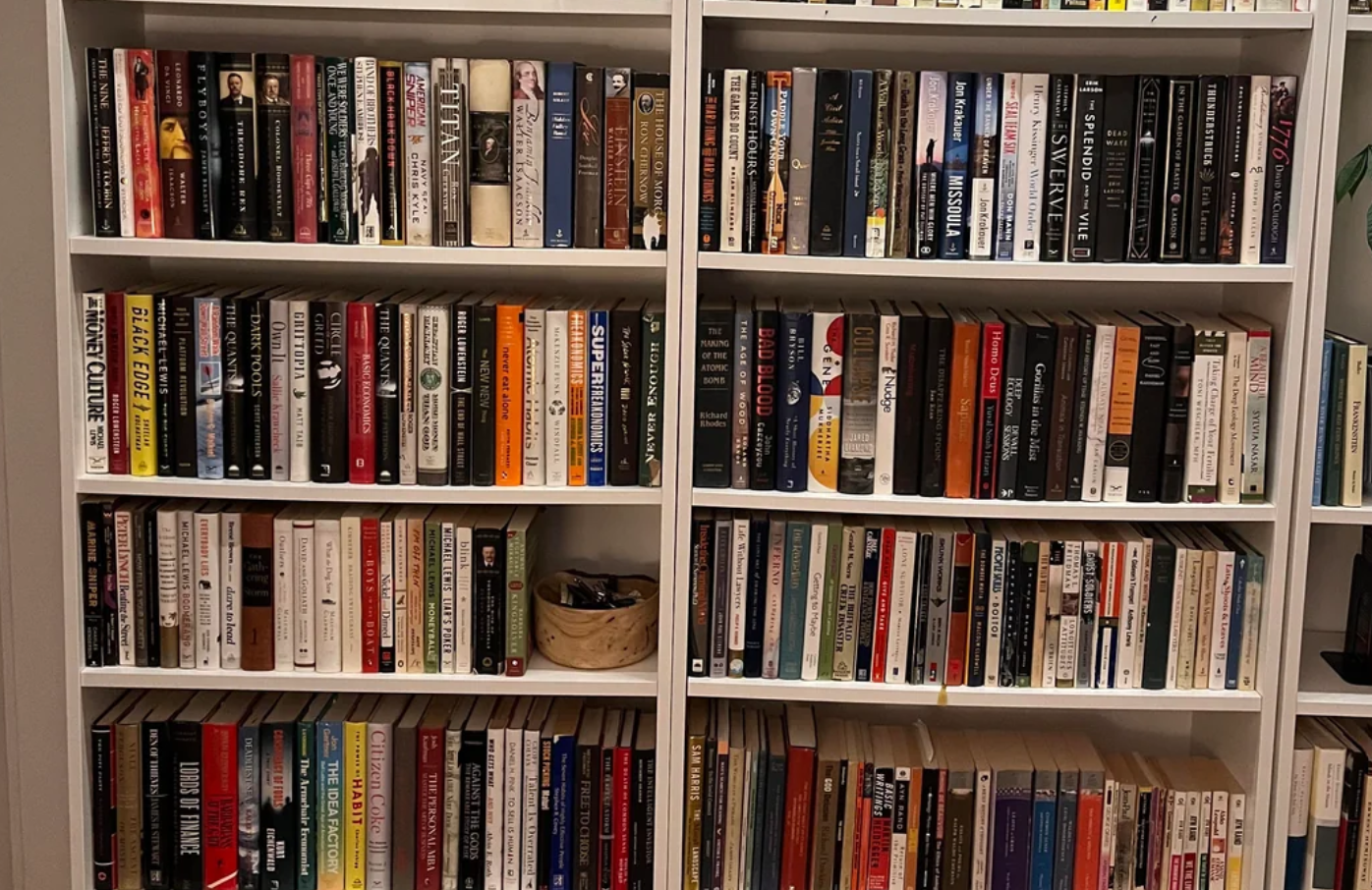
Shelfology Book Pairing
Outliers
The Story of Success
by Malcolm Gladwell
From the bestselling author of Blink and The Tipping Point, Malcolm Gladwell's Outliers: The Story of Success overturns conventional wisdom about genius to show us what makes an ordinary person an extreme overachiever. Why do some people achieve so much more than others? Can they lie so far out of the ordinary? In this provocative and inspiring book, Malcolm Gladwell looks at everyone from rock stars to professional athletes, software billionaires to scientific geniuses, to show that the story of success is far more surprising, and far more fascinating, than we could ever have imagined. He reveals that it's as much about where we're from and what we do, as who we are - and that no one, not even a genius, ever makes it alone. Outliers will change the way you think about your own life story, and about what makes us all unique. 'Gladwell is not only a brilliant storyteller; he can see what those stories tell us, the lessons they contain' Guardian 'Malcolm Gladwell is a global phenomenon ... he has a genius for making everything he writes seem like an impossible adventure' Observer 'He is the best kind of writer - the kind who makes you feel like you're a genius, rather than he's a genius' The Times
The Signal and the Noise
Why So Many Predictions Fail--but Some Don't
by Nate Silver
"One of the more momentous books of the decade." —The New York Times Book Review Nate Silver built an innovative system for predicting baseball performance, predicted the 2008 election within a hair’s breadth, and became a national sensation as a blogger—all by the time he was thirty. He solidified his standing as the nation's foremost political forecaster with his near perfect prediction of the 2012 election. Silver is the founder and editor in chief of the website FiveThirtyEight. Drawing on his own groundbreaking work, Silver examines the world of prediction, investigating how we can distinguish a true signal from a universe of noisy data. Most predictions fail, often at great cost to society, because most of us have a poor understanding of probability and uncertainty. Both experts and laypeople mistake more confident predictions for more accurate ones. But overconfidence is often the reason for failure. If our appreciation of uncertainty improves, our predictions can get better too. This is the “prediction paradox”: The more humility we have about our ability to make predictions, the more successful we can be in planning for the future. In keeping with his own aim to seek truth from data, Silver visits the most successful forecasters in a range of areas, from hurricanes to baseball to global pandemics, from the poker table to the stock market, from Capitol Hill to the NBA. He explains and evaluates how these forecasters think and what bonds they share. What lies behind their success? Are they good—or just lucky? What patterns have they unraveled? And are their forecasts really right? He explores unanticipated commonalities and exposes unexpected juxtapositions. And sometimes, it is not so much how good a prediction is in an absolute sense that matters but how good it is relative to the competition. In other cases, prediction is still a very rudimentary—and dangerous—science. Silver observes that the most accurate forecasters tend to have a superior command of probability, and they tend to be both humble and hardworking. They distinguish the predictable from the unpredictable, and they notice a thousand little details that lead them closer to the truth. Because of their appreciation of probability, they can distinguish the signal from the noise. With everything from the health of the global economy to our ability to fight terrorism dependent on the quality of our predictions, Nate Silver’s insights are an essential read.
These books are Distant Cousins
These books sit together on 2 different collections in our database