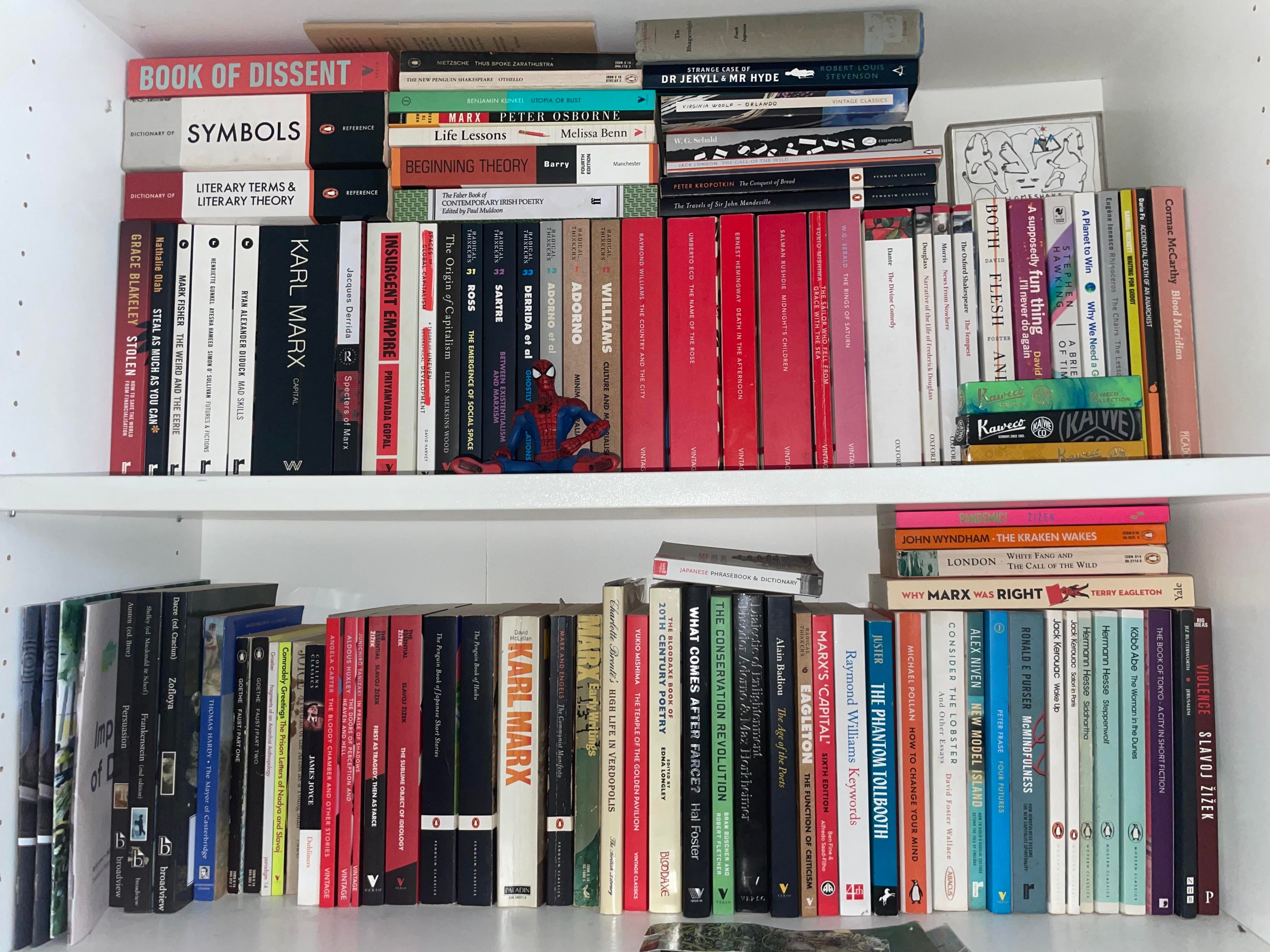
Shelfology Book Pairing
Thus Spoke Zarathustra
A Book for Everyone and No One
by Friedrich Nietzsche
Friedrich Nietzsche's most accessible and influential philosophical work, misquoted, misrepresented, brilliantly original and enormously influential Nietzsche was one of the most revolutionary and subversive thinkers in Western philosophy, and Thus Spoke Zarathustra remains his most famous and influential work. It describes how the ancient Persian prophet Zarathustra descends from his solitude in the mountains to tell the world that God is dead and that the Superman, the human embodiment of divinity, is his successor. Nietzsche's utterance 'God is dead', his insistence that the meaning of life is to be found in purely human terms, and his doctrine of the Superman and the will to power were all later seized upon and unrecognisably twisted by, among others, Nazi intellectuals. With blazing intensity and poetic brilliance, Nietzsche argues that the meaning of existence is not to be found in religious pieties or meek submission to authority, but in an all-powerful life force: passionate, chaotic and free. For more than seventy years, Penguin has been the leading publisher of classic literature in the English-speaking world. With more than 1,700 titles, Penguin Classics represents a global bookshelf of the best works throughout history and across genres and disciplines. Readers trust the series to provide authoritative texts enhanced by introductions and notes by distinguished scholars and contemporary authors, as well as up-to-date translations by award-winning translators.
The Sublime Object of Ideology
by Slavoj Žižek
In this provocative and original work, Slavoj _i_ek takes a look at the question of human agency in a postmodern world. From the sinking of the Titanic to Hitchcock’s Rear Window, from the operas of Wagner to science fiction, from Alien to the Jewish Joke, the author’s acute analyses explore the ideological fantasies of wholeness and exclusion which make up human society. _i_ek takes issue with analysts of the postmodern condition from Habermas to Sloterdijk, showing that the idea of a ‘post-ideological’ world ignores the fact that ‘even if we do not take things seriously, we are still doing them’. Rejecting postmodernism’s unified world of surfaces, he traces a line of thought from Hegel to Althusser and Lacan, in which the human subject is split, divided by a deep antagonism which determines social reality and through which ideology operates. Linking key psychoanalytical and philosophical concepts to social phenomena such as totalitarianism and racism, the book explores the political significance of these fantasies of control. In so doing, The Sublime Object of Ideology represents a powerful contribution to a psychoanalytical theory of ideology, as well as offering persuasive interpretations of a number of contemporary cultural formations.
These books are Distant Cousins
These books sit together on 2 different collections in our database