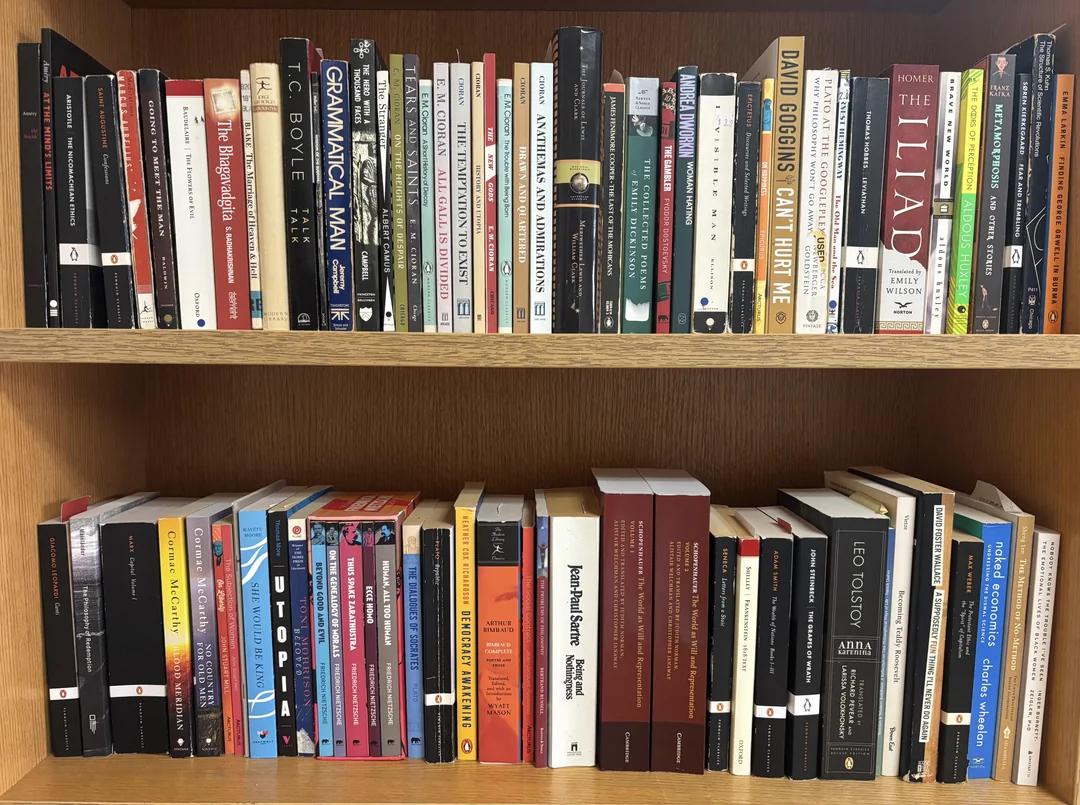
Shelfology Book Pairing
Brave New World
Enriched edition.
by Aldous Huxley
Aldous Huxley's "Brave New World" presents a chilling vision of a dystopian future characterized by the pervasive influence of technology and state control over individuals. Written in 1932, this novel employs a satirical yet cautionary tone, utilizing rich, ironic prose to explore the loss of individuality in a society driven by consumerism, genetic engineering, and hedonism. Huxley crafts a technologically advanced world where human beings are conditioned from birth to embrace a predetermined social order, raising profound ethical questions about freedom, happiness, and the cost of progress. Aldous Huxley, a member of a prominent scientific family, was deeply influenced by both the Enlightenment ideals of progress and the emerging anxieties of the early 20th century. His exposure to the early theories of psychology, biology, and the effects of totalitarianism shaped his critical perspective on modern civilization. "Brave New World" serves as both a product of its time and a prophetic warning, reflecting Huxley's concerns about the dehumanizing potential of technological advancement and the inherent risks of sacrificing individuality for societal stability. This landmark work is an essential read for anyone interested in the interplay between technology, society, and human values. Huxley's masterful narrative invites readers to reflect on the moral dilemmas of contemporary life, making it a timeless exploration of the balance between progress and humanity. Engage with "Brave New World" to apprehend its enduring relevance in an age increasingly dominated by technological advancement. In this enriched edition, we have carefully created added value for your reading experience: - A comprehensive Introduction outlines these selected works' unifying features, themes, or stylistic evolutions. - The Author Biography highlights personal milestones and literary influences that shape the entire body of writing. - A Historical Context section situates the works in their broader era—social currents, cultural trends, and key events that underpin their creation. - A concise Synopsis (Selection) offers an accessible overview of the included texts, helping readers navigate plotlines and main ideas without revealing critical twists. - A unified Analysis examines recurring motifs and stylistic hallmarks across the collection, tying the stories together while spotlighting the different work's strengths. - Reflection questions inspire deeper contemplation of the author's overarching message, inviting readers to draw connections among different texts and relate them to modern contexts. - Lastly, our hand‐picked Memorable Quotes distill pivotal lines and turning points, serving as touchstones for the collection's central themes.
The Apology
by Plato
- Translated with an introduction by Benjamin Jowett. The Apology is Plato's version of the speech given by Socrates as he defended himself in 399 BC against the charges of "corrupting the young, and by not believing in the gods in whom the city believes, but in other daimonia that are novel" (24b). "Apology" here has its earlier meaning (now usually expressed by the word "apologia") of speaking in defense of a cause or of one's beliefs or actions. The general term apology, in context to literature, defends a world from attack (opposite of satire-which attacks the world). Xenophon, who wrote his own Apology of Socrates, indicates that a number of writers had published accounts of Socrates' defense. According to one prominent scholar, "Writing designed to clear Socrates' name was doubtless a particular feature of the decade or so following 399 BC". Many scholars guess that Plato's Apology was one of the first, if not the very first, dialogues Plato wrote, though there is little if any evidence. Plato's Apology is commonly regarded as the most reliable source of information about the historical Socrates. Except for two brief exchanges with Meletus (at 24d-25d and 26b-27d), where the monologue becomes a dialogue, the text is written in the first person from Socrates' point of view, as though it were Socrates' actual speech at the trial. During the course of the speech, Socrates twice mentions Plato as being present (at 34a and 38b). There is, however, no real way of knowing how closely Socrates' words in the Apology match those of Socrates at the actual trial, even if it was Plato's intention to be accurate in this respect. One contemporary criticism of Plato's Apology is perhaps implied by the opening paragraphs of Xenophon's Apology, assuming that the former antedated the latter; Xenophon remarks that previous writers had failed to make clear the reason for Socrates' boastful talk in the face of the death penalty. Xenophon's account disagrees in some other respects with the details of Plato's Apology, but he nowhere explicitly claims it to be inaccurate.
These books are Distant Cousins
These books sit together on 2 different collections in our database