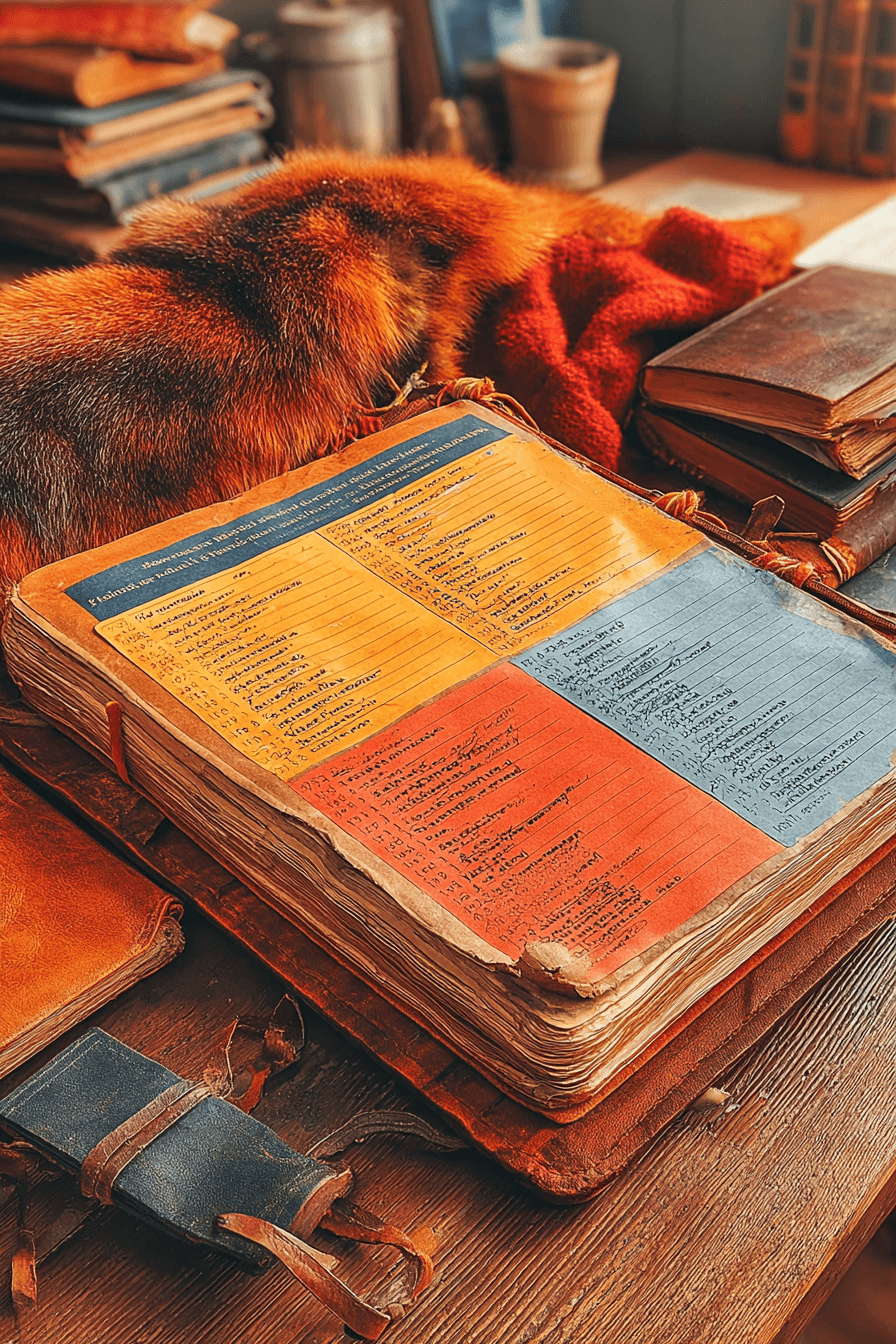
Darwin kept a list of every book he read from 1838 until 1860 — organized by year, sometimes with one-line reactions. The notebooks are held at Cambridge and have been published through the Darwin Correspondence Project. Most people know Darwin the theorist. Almost nobody knows Darwin the reader.
The Notebooks
What the lists reveal is how wide his curiosity ran beyond the natural sciences. History, economics, travel writing, novels. He read Pride and Prejudice twice and noted it “admirable.” He rated philosophical works on a private three-point scale. Malthus’s Essay on Population appears in the 1838 entries — the year Darwin first formulated the mechanism of natural selection. The connection between the reading and the thinking is not metaphorical. It is sequential. He read Malthus, and then he had the idea.
The notebooks are not a bibliography. They are a record of decisions: what to pick up next, what to return to, what to abandon. Each entry is a small commitment of time and attention — the kind of commitment that, accumulated over twenty-two years, produced something no single book could have produced alone.
A man who dares to waste one hour of time has not discovered the value of life. — Charles Darwin
What makes the notebooks unusual is not that Darwin read widely — many Victorian naturalists did — but that he recorded it. The record turns private reading into observable data. We can see which books sat next to which. We can see what a working scientist actually reached for when he had a problem to solve.
One Shelf, Many Signals
A single reader’s shelf is already revealing. The books a person chose to keep — the ones they agreed to house — form a kind of intellectual fingerprint. The composition tells you things the reader might not tell you themselves: what subjects they kept returning to, which authors earned permanent shelf space, where their curiosity crossed disciplinary lines.
Darwin’s notebooks are the nineteenth-century version of this. They are a shelf in time — a longitudinal record of what one serious reader found worth reading, year after year, while doing the hardest intellectual work of his life.
But Darwin is one reader. One fingerprint. One shelf.
The Aggregate
Now imagine thousands of shelves. Not curated reading lists posted for public consumption, not algorithmic recommendations optimized for purchase, but actual bookshelves — photographed in living rooms, bedrooms, and home offices. Each one is a record of the same kind of decision Darwin made every time he picked up a new volume: this book is worth the space it takes up in the room where I live.
This database exists. It has always existed. It is hiding in plain sight, distributed across millions of homes, visible in the background of every video call and every interview and every real estate listing that accidentally includes a bookcase. Nobody has read it — not because the information is hidden, but because nobody thought to look at bookshelves as data rather than furniture.
The interesting thing about aggregated shelf data is not that it confirms what you already know. Of course Sapiens appears on many shelves. Of course business readers own copies of Thinking, Fast and Slow. The interesting thing is what you don’t expect. It is the pairings — the specific books that keep turning up together on unrelated shelves, owned by readers who have never met and who would have no obvious reason to own both.
The Unlikely Pair
A recommendation algorithm works by finding what is similar. A shelf works differently. Shelves record what a reader actually lived with, which means they record the full range of a reading life — not just the cluster of books that match a single interest, but the outlier that sits between the philosophy and the business strategy, the novel that somehow ended up next to the cognitive science.
These unlikely pairings are, in practice, the most useful signal a bookshelf can produce. The book that shows up on twelve different shelves alongside a book you already love — but that belongs to a different genre, a different tradition, a different century — is precisely the kind of recommendation no algorithm would surface. It is the recommendation that expands your reading rather than reinforcing it.
This is what Darwin’s notebooks show in miniature. The value of his reading was not in the natural history. It was in the adjacency — Malthus next to Lyell, Austen next to Humboldt, political economy next to barnacle taxonomy. The reading that mattered was the reading that crossed boundaries.
Shelfology
We call this kind of adjacency analysis Shelfology — the study of which books end up together on real shelves, and what those pairings reveal about how readers actually navigate knowledge. It is not a recommendation engine in the conventional sense. It does not predict what you will click on. It surfaces what thousands of serious readers, independently, chose to keep in the same room — and lets you consult that aggregated judgment when deciding what to read next.
The argument for this approach is simple. When you have read five or six books on a subject and each new title overlaps more with what you already know, the most useful next book is not the most obvious one. It is the one at the edge of your current reading — the book that shares a shelf with what you know but belongs to territory you have not yet entered.
No algorithm can find that book by analyzing your purchase history. But a shelf can find it — or rather, the accumulated evidence of thousands of shelves can find it, because somewhere, a reader who read the same five books you read also kept a sixth book that you have never heard of. That sixth book is the signal.
Darwin’s notebooks are the earliest example we have of what becomes visible when a serious reader’s choices are recorded rather than remembered. The question Shelfology asks is what becomes visible when that recording scales — when the notebooks are not one man’s private list, but the collected shelves of every reader who agreed to share what they chose to live with.
The answer is still emerging. But the data is no longer hiding. It is sitting on the shelves, waiting to be read between the spines.